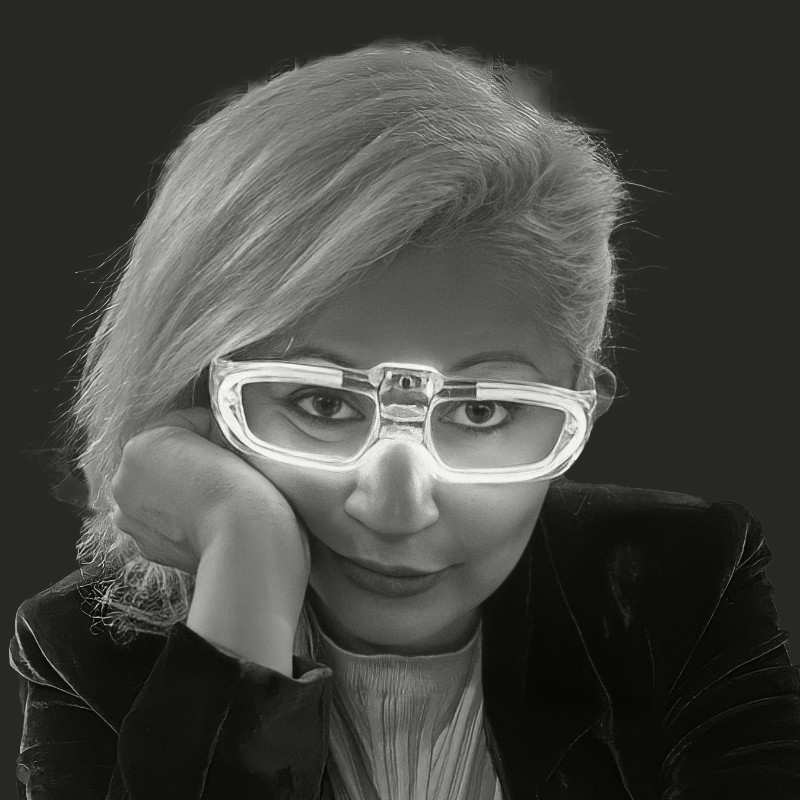
 Lina Lopes
 Preparing a bio-interface for imagination
Note: This post (and the Codex) is written in English. The entire activation at the festival—workshop, conversations, and panel—will be held in Portuguese, in Rio de Janeiro (BR).
What we’re about to build
Can we craft a bio-interface for imagination itself—linking brain signals, lab-grown neural tissue, and machine learning so creative processes can be translated beyond the human body? That is the question animating Creativity in vitro, our ongoing art–science project.
We align with Futuros Possíveis by probing the relation between body–brain, imagination, and machines, and by proposing ways to re-enchant the future through situated experiments.
Why now, why here
The festival’s theme invites us to stage sensory, ethical, and speculative encounters with data from the brain and with AI—treating language and imagination as technologies of re-enchantment.
Our project stands on two intertwined phases:
- Phase 1 — Interface for Imagination. We collect EEG data and train models to associate neural patterns with visual concepts—thoughts-to-image, not text-to-image—starting from mental instructions like “imagine the sun on your face” and expanding to internal imagery.
- Phase 2 — Artist in the Dish. We venture into speculative biology with neural organoids, asking whether lab-grown neurons can respond to stimuli and express creative patterns in vitro. What does it mean to “train a brain that has never lived”?
What we will activate at the festival
1) Immersive experience + open talk
A dark room becomes a thinking surface: four worktables with artifacts from our process; a stained-glass panel of Petri dishes with brain-wave visualizations; projections and screens showing a short doc and generative images. Inside this living studio we’ll host an open conversation about method, ethics, and poetic outcomes.
Why step inside: enter our “brain-atelier-laboratory,” read with the body (not only the cortex), and trade ideas in a space where concepts are cultivated like neurons in culture media.
2) Co-creation studio: from memory to speculation
|  |
We begin with a significant object. Each participant traces its material story and keywords. Then we flip the premise: what if this object were an interface to a living AI? We sketch speculative futures with quick drawings and visual AI prototypes (e.g., DALL·E, Nano Banana, Midjourney), turning memories into radical fabulations about brain, body, and machine.
When & where: 24 Oct, 10:00–12:00 — EDUCA FREIRE (festival venue).
3) Panel — Mentes, Máquinas e Matéria
|  |
What happens when artists, scientists, and technologies create together? We discuss brain signals, organoids, ML/AI, and the possibility of translating creative processes before language—opening questions on co-creation with living systems.
When & where: 24 Oct, 14:00 — ARENA AUDITORIUM.
Why listen: to see how art and science can be practiced beyond labs and galleries, as accessible, living processes—and how imagination itself can be treated as a design material.
Agenda (at a glance)
-
24 Oct — 10:00–12:00 · Co-creation studio (Educa Freire) — Neurodesign especulativo.
-
24 Oct — 14:00 · Panel (Arena Auditorium) — Mentes, Máquinas e Matéria.
-
Immersive experience running throughout the festival; open talk held inside the space.
Mad Scientists
Lina Lopes & Eduardo Padilha. Artists–researchers exploring whether creative processes can be cultivated and translated outside the human body, connecting EEG, neural organoids, and machine learning. Collaborations include CloudWalk, University of Bern, and researchers at UFABC.
 mm3 creativity